Friday, November 21, 2008

Week 10 Creative Computing - Integrated setup - Ableton Sampler

I'm not sure if this was week 9 or 10.....

We (Jamie and I) tried to demonstrate the concepts taught in class by quickly creating a sampler instrument using some short snippets of clarinet that we recorded in class. 

As demonstrated, we used a haphazard approach, using any samples and processing as needed to make drum sounds within the sampler. It is interesting that the source material hardly matters as long as it's interesting. This philosophy even applied to rhythms to some extent. Many of them were created by randomly pasting midi data around and transposing it. 

The effects available in live also make it easy to do something obvious quickly. We used the 'grain delay' and the 'erosion' on a bus to add a pleasing layer of white noise to the sound. 

With two layers of drums, one proper tonal instrument, and a bit turning loops on and off, we made 1'28 of electronic music!


Reference: Christian Haines. "Integrated Setup II." Lecture presented at the Electronic Music Unit, University of Adelaide, 14 October 2008.

Thursday, November 20, 2008

Audio Arts Major Project


Draft Mix MP3

I aimed to recreate the sound of the windy seaside staying quite faithful to the events of the recording I made. The main elements I included were wind, birds, cars, dog, rumble, rummaging, and footsteps. Part of the objective was for the final product to have a hyper-real sheen to it, which allows for some deviation from the original recording.

In order to achieve the hyper-real texture, synthesis was my main approach to sound creation. My main synthesizer was Plogue Bidule, as its flexible modules and routing options allow for a wide variety of timbres. I found some sounds far harder than others to generate.

Wind was a main focus, because it was dominant in the original recording. I created a Bidule patch with 8 channels of noise and independent filters. The frequency of the filters was determined by independent random oscillators, and also a master control, so that the 8 channels are independent but linked to some degree. A rumble adds depth and cinematic hyper-realism. While I have tried to evoke the sea using wind and rumble sounds, I think that the real ocean does make water sounds that my simulation lacks.

Glass was also tackled with Bidule, using an FM synthesis patch with modulation envelopes. After generating files of randomly varied glass sounds, I compiled them in logic to simulate the simultaneous clinking of many bottles. Many different sequences were bounced from separate logic session and later used in the main session.

Percussive hitting sounds proved to be some of the most difficult to recreate. I tried to process white noise, but my results were largely corny and reminiscent of poor films. In this case, I abandoned synthesis and quickly recorded myself hitting various objects on the desk in front of me. By taking small portions of this recording, timestretching them and using EQ, reverb and enveloping, I was able to create some marginally better foley sounds. I think that these percussive sounds are the weak point of the work – particularly the footsteps.

In the final mix, heavy EQ and short reverbs proved to increase the realism of many of the sounds. Pan automation allowed elements such as cars, bikes and dogs to move around.

I’m satisfied with my final product, however I think that improvement is possible, particularly with the rummaging sounds. Through this exersize, I have realised how difficult synthesizing real sounds is.

Creative Computing Major Project


Performance Recording Mix

This electroacoustic performance work for trumpet and computer builds from a gentle beginning by layering sound electronically. In order to explore a live improvisation aesthetic, the performance makes use of no pre-existing audio recordings, or rhythmic data. Only a basic form for the work was pre-decided, and the trumpet player largely improvised. This demonstrates that the musical outcome of electronic processing of sound relies little on the source material and more on the types of processes used. The work also explores what defines a piece of electronic performance music. The unique pre-existing aspect of this work is simply a particular processing and temporary recording array that has been configured to be interacted with in a particular way. One computer file, corresponding softwares, and any acoustic instrument are the only materials needed to reproduce the work. Thus, a file replaces a traditional music score.

Every sound that is heard originated from the instrumentalist at some point during the performance. The introduction contains a prominent pulsing that results from realtime processing of the trumpet. In order for the work to progress, the role of the software operator is largely in planning ahead by recording useful excerpts, which can later be creatively manipulated. Jamie was occupied with providing interesting source material through his self-taught trumpet style.

The relationship between the electronics and acoustic instrument are different in different parts of the work. In the gentle sections, Jamie was able to improvise with the setup and receive immediate feedback. In order to create the beat, he interacted with the equipment in a fixed, predecided way by making drum sounds. In louder sections, he is able to play over the music in a traditional manner as if it is separate musician.

Saturday, November 1, 2008

Week 12 Forum - Stephen steers the university battleship through oceans of amusement


Basically we discussed the course (and anything else we that came up).

There were some really interesting points raised about the nature of education, particularly in an artistic field. Is it actually possible to have an argument with Stephen? I suspect not - even if you get close, he'll pull out a wise cooking metaphor and make you stop and consider.

I agree with David that studying art that you don't (yet) enjoy is a mind opening process that is always a good thing, particularly if it's very developed art.

The stuff I said in forum was kind of just a rant and wasn't very clear, so I don't think it was very helpful. But when I mentioned Year 12 Music Tech, what I actually had at the back of my mind was that it's kind of opposite to this course. Here, we are all taught a wide range of techniques, must analyse a wide range of fixed styles, and then have to create music that uses particular techniques in a particular style. Last year, it was entirely about thinking of a sound you like and then heading for it, and all the tuition was about developing your particular compositions.

Well the outcome is that I consider pretty much everything I've done musically before the last 6 months to be embarrassingly boring really... so I think it's better to learn techniques, then take a breath and quickly make some music every now and then. Maybe this is because in electronic mediums, much of the originality come in the techniques of creating sound, and there are limitless undiscovered methods.

Reference: Stephen Whittington. "Music Studies (Music Technology) Course Feedback." Lecture presented at the Electronic Music Unit, University of Adelaide, 30 October 2008.

Wednesday, October 29, 2008

Week 9 Audio Arts - FM Synthesis

Audio Demo

Basic FM Synth
A simple FM synth based on the readings using one carrier and one modulator. The amplitude of the modulator is controlled in such a way that at 1.0, the frequency of the carrier moves between 0 and 2f (f is the note being played).

One envelope controls the overall output, while another controls the modulation depth.

I found that this simple FM setup was actually very effective for recreating real world sounds, particularly metallic percussion sounds. I was so proud of my gamelan emulation (reverb helped), that I had to design some upbeat gamlan elevator music (see audio demo). I think we should install this in the new Schulz elevator when no-one's looking.

Badass FM Synth
I tried expand the concept by using five oscillators linked in a chain so each oscillator modulates the next, so I suppose there are four modulators and one carrier. Each modulation stage has it's own modulation depth envelope. You can take audio feeds from the last three oscillators in the chain and mix them in stereo.

It did create some complex noisey textures, however I found it hard to create anything that was particularly real world by making use of the extra oscillators.

Reference: Christian Haines. "Additive Synthesis." Lecture presented at the Electronic Music Unit, University of Adelaide, 14 October 2008.

Tuesday, October 28, 2008

Week 10 Audio Arts - Additive Synthesis

Can I have the award for artistic patching? Impressionism vs bidule layouts....

Audio Demo


It's a midi controlled additive synth. You get 6 oscillators, and you get to choose the ratio of their frequencies to the midi note, their amplitude, and their wave type. There is a simple amplitude envelope to control the shape of the sound. It's polyphonic.

More Extreme Additive Synth (pictured)
There are 16 oscillators, each contained in a group. The oscillators are automatically mapped as harmonics in relation to the defined fundamental, however if you want a rougher tone, they can be scattered slightly using the "Freq Freakout Factor".

The amplitude of each oscillator is determined by a set ratio of the previous oscillator, creating a decreasing exponential curve. For example, if the "amp taper factor" is at 0.5, then every harmonic will be half the value of the previous one.

The amplitude of odd and even harmonics can be boosted and cut.

Frequency, pan, and amplitude can be varied individually using random value generators for each oscillator, creating evolving textures.

It's all pretty processor intensive, cause there are a total of 64 oscillators running simultaneousy (including the random modulators).

Reference: Christian Haines. "Additive Synthesis." Lecture presented at the Electronic Music Unit, University of Adelaide, 21 October 2008.

Saturday, October 25, 2008

Week 8 Audio Arts - Amplitude/Ring Modulation


Image (it won't insert properly)


I created an amplitude modulation patch and a ring modulation patch.

The amplitude modulation patch is basically for modulating oscillators that process a carrier in series one after the other.

My second patch (pictured) uses three oscillator. In each "iteration", the three possible combinations of two signals are ring modulated, and three new signals are created. The process is performed 8 times, however there is rarely much signal left at this point. An iteration selector fades between the 8 different stages so you can dynamically move from slight modulation to grainy noise. The 3 outputs can be individually panned to create a true rich stereo signal where the different channels are different but related. 

I wasn't very successful in creating organic sounds, however many types of rich machine sounds were easily accessible. An engine noise from this patch should be usable for the major project. Putting noise through the system created some interesting buffeting wind. The stereo output should be useful in a soundscape.

Reference: Christian Haines. "Amplitude and Ring Modulation." Lecture presented at the Electronic Music Unit, University of Adelaide, 7 October 2008.

Week 9 Creative Computing - Integrated Setup


Jamie and I created a piece by improvising using an integrated setup involving Bidule, Live, the Novation controller, an acoustic guitar, an SM57, and the Mackie mixer.

Within the computer, the Bidule patch was something I have been experimenting with at home in preparation for the major project - this is the first time I've used it with live audio. The string sound is from a pleasing sample we quickly loaded into the simpler in live (with reverb and delay). Bidule was the rewire host, and live was simply rewired in to provide the string sound.

I played synth strings via Novation and tweaked minor parameters of the Bidule patch during the performance while Jamie played guitar. I would have liked to have more control over Bidule, but that will require some further tweaking. I think that using the software with live audio input where we could experiment and interact with it helped us gain better results.

Obviously we used much pre-existing patching in the setup, however I think that we still created an interesting live performance by adding sound and interacting with the patch.

Reference: Christian Haines. "Integrated Setup I." Lecture presented at the Electronic Music Unit, University of Adelaide,  7 October 2008.

Thursday, October 16, 2008

Week 10 Music Tech Forum - Honours Presentations


Presentations from the honours students!

I really loved the animation projects of the first speaker. The animations were really pretty and I think the music fitted them perfectly. I loved the piano style and the vocals and I think I could listen to it on CD for enjoyment. A very comfortable contrast to what we normally hear in forum... but there is a place for that too.

The concept of the program that sonifies network data was totally awesome. I really like the way that it artistically represents the modern world where we're surrounded by machines that are automatically sending each other huge amounts of information before we even ask them to fetch us anything. It's a noisy society where we're bombarded with information from all angles, so why not convert it into music?

I guess what the program currently lacks on the musical front is a way to give the results some kind of macro form...

I was also wondering if the program can pull much meaning from the data values? For example, is it very different to modulating the values of the synth with a random oscillator? But I think these problems can be solved (don't ask me how). 

Reference: Stephen Whittington. "Week 10 Music Technology Forum - Honours Student Presentations." Lecture presented at the Electronic Music Unit, University of Adelaide, 16 October 2008.

Wednesday, October 15, 2008

Week 9 Forum - 3rd Year Presentations!

The third year presentations were all really impressive. I'll just describe that ones that come to mind first.....

Probably my favourite listening experience was the surround supercollider experience. This is partly because this is not something I'm used too but I reckon it's a worthwhile endeavor. I think that the current consumer craze is a little stupid cause I'd much prefer decent stereo sound than poor surround and a lower mids gap between the sub and sattelite speakers....

But luckily the Blue Skys have no such problems.... I loved being able to close my eyes and imagine I was in a jungle of crazy machines. I enjoy Super Collider's glassy sound sometimes (during 3rd year presentations). I'd like to hear it used with other contrasting elements.

The piano chord generator really interested me. I understand the chord choosing algorithm, but I didn't quite get how the rhythm generator works. I think was a really impressive example of this kind of patch. The output sounded really quite musical, I think because of the clever chord voicing system.

The melody warper was a rad idea that worked well I think however I was a bit distracted by all the changes of tempo (which were a good idea). I think it would be awesome to record the midi and render it elsewhere...

Reference: Stephen Whittington. "Week 9 Music Technology Forum - 3rd Year Presentations." Lecture presented at the Electronic Music Unit, University of Adelaide, 9 October 2008.

Wednesday, September 24, 2008

Week 8 Forum - Eraserhead

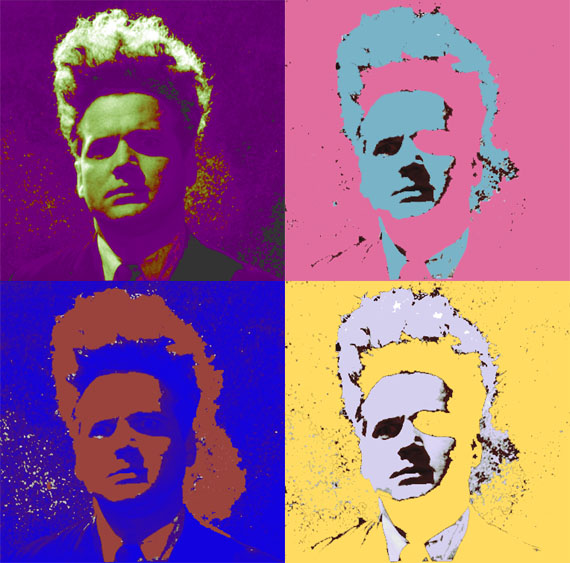
I was fairly excited to watch Eraserhead because I keep hearing about Lynch and I don't think I've seen any of his other films. I really enjoyed it - I'd definitely prefer to see something totally different than another boring movie stamped out of the usual mould.

There are some favourite moments.... I love the way Lynch manages to ironically reserve dialogue for completely obvious, pointless remarks. "Oh... you are sick" was insanely funny in my opinion, as well as "like regular chickens" and a few others. That explains why there is an Amon Tobin song of that name....

I like the way we do very different things in forum every week, and I think that watching a fairly experimental movie is a worthwhile endeavour when many of us are interested in film sound design and music. The constant rumbles and drones created a strong atmosphere and I thought they had a pleasantly solid tonal character. The contrast of the music and noise was very effective. 

I also think that all art forms influence each other in interesting ways and so it is a good thing to find interesting works in other disciplines.

Reference: David Harris. "Week 8 Music Technology Forum - Eraserhead." Lecture presented at the Electronic Music Unit, University of Adelaide, 18 September 2008.

Friday, September 12, 2008

Week 7 Audio Arts - Analog Synthesizers!

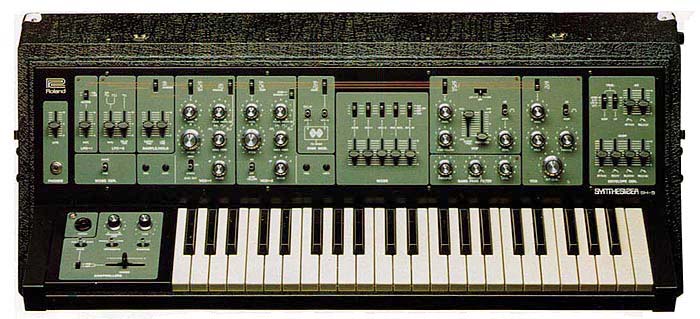
Above is a Roland SH-5 which I attempted to create some organic sounds with. It feels great to be playing with something that isn't a computer. The many controls allow easy realtime control to manually add that modulation you need without bothering to assign things to an LFO or modwheel. I used the pitch lever often to control pitch or filter in order to move it exactly as I needed. 


I found it quite surprising that it isn't too hard at all to obtain a few reasonably organic sounds, though I ran out of inspiration quickly.

The wind was created by filtering white noise with the LP and BP and I added in a slight whistle created by ring modulating the oscillators together.

I think I did the bird noises by increasing the resonance of the filter till it self oscillated. I then set up a suitable envelope and swept the filter with the pitch stick while playing notes.

Other sounds are fairly obvious! The white noise oscillator makes it all possible because otherwise we could only do pitched sounds.

Reference: Christian Haines. "Week 7 Audio Arts - Analog Synthesizers." Lecture presented at the Electronic Music Unit, University of Adelaide, 6 September 2008.


Week 8 Creative Computing - Ableton Live 2 - Let's Do the Time Warp Again Please


The Audio File

Here's my project for this week - it uses a bunch of samples from a recording of a school concert, a musical, and a rock band.

The warp markers were extremely useful to me. This interface for matching loops is so intuitive and accurate and makes it easy to work with looser beats that may fluctuate in tempo. It is so quick it would be feasible to do minor editing with this feature while playing live. I think the performance aspect of this software can be good when working with samples, because often really interesting combinations are found by trial and error which is easy in a performance environment.

I find myself losing touch with the macro form of the piece when sequencing live, however this is easily tidied up in the arrangement view. In creating this 45 second piece, I actually created a 2:20 groove and then raised the tempo and judiciously used "delete time" to get rid of the less interesting parts.

I had to just go for it and work quickly knowing that I couldn't save and improve the song incrementally over many sessions. This approach forced me to be more productive, creative and heavy-handed.

Reference: Christian Haines. "Week 7 Creative Computing - Ableton Live". Lecture presented at the Electronic Music Unit, University of Adelaide, 6 September 2008.

Week 7 Creative Computing


Wasn't sure if it needs to be 45 seconds or not?

Groove 2 MP3 (cut to 45 seconds)


I practiced a little at trying to get all the samples loaded really quickly and then switching scenes at the right moment. I think that the realtime nature of this software makes it an instrument that requires practice to really be able to improvise quickly. I wasn't able to do very much at all after 45 seconds, however with a little longer I was able to explore more, changing the loop length in order to switch time signature and create polyrhythms.

There are some quite good live DJ-type effects such as the "grain delay" which I used on trent's vocal. The XY controls are obviously geared towards performance.

I think the key/midi control options would really improve the agility of the performance if the "player" is skilled, however some setting up of the project may be required to make use of them.

The immediate nature of this performance sequencer and its restriction of saving meant that in some grooves I had happy accidents and discovered a new technique, effect, or sample combination while improvising. This is an example of the way in which restrictions may be conducive to creativity, which is then sped up by the focus on live performance.

Reference: Christian Haines. "Week 7 Creative Computing - Ableton Live." Lecture presented at the Electronic Music Unit, University of Adelaide, 6 September 2008.

Thursday, September 11, 2008

Week 7 Forum - Second Year Presentations

Super Collider

The second and and some third years showed us what they have been up to. This consisted mainly of max and supercollider patches.

I enjoyed it all! Sanads dance piece was pretty extensive for something he made last night.... I enjoyed it. He suggested that it is quite different to the dance music that people like, but I'm not so sure.... Other than the 6/8 time signature, I don't think its that different from what I've heard. I think this is probably because I don't understand the intricacies of dance music at all.

Edward's visual patch was way cool - very impressive and I liked that he could tweak parameters and get really different patterns.

The chord progression generator seems like a very useful device, even if it is just there for inspiration. The grid probability approach seems quite intuitive.

Freddie's "game" idea for his Max patch was really hilarious - I love it. Never would have thought about turning algorithmic composition into a game! Get your kids into max/msp this way......

I thought the supercollider stuff was interesting but it looks like heaps of work to get decent organic textures. That said - John Delaney did an amazing job of getting beautiful sounds from the code, and Matt's Fatboy Slim sample was absurdly rad.

Reference: Stephen Whittington. "Week 7 Music Technology Forum - 2nd and 3rd year presentations." Lecture presented at the Electronic Music Unit, University of Adelaide, 11 September 2008.

Week 6 Creative Computing - More Logic Skills


I found it rather difficult to apply many of the new skills taught in the tutorial to a song that had already been completed. In order to try to demonstrate the techniques and make a noticeable change to the song, I've made some adjustments.....

Added the enveloper to the drums. I've overdone it to the point where there is too much attack but at least you can tell it is there. I found this plugin more useful on my own recordings.

Humanized the drums. The timing and velocity is just slightly randomized and I think it makes the looping a little less obvious.

I added reverb to the instruments so they sound a little more dub. Particularly the drums have a very fake cavernous effect (I chose this deliberately in space designer).

Redid the arrangement a little.

Last minor touch.... REPLAYED THE MELODY THROUGH AN ARPEGGIATOR! which I lovingly configured in the environment as per screenshot above. One note is converted to a chord via transformers and then tastefully arpeggiated [to hell and back] to develop the melody and add a minimalist flavour.

Reference: Christian Haines. "Week 6 Creative Computing - Logic Skills 3." Lecture presented at the Electronic Music Unit, University of Adelaide, 2 September 2008.

Week 6 Audio Arts - Interaction Design - Age of Mythology


The menu includes options related to which ancient God you choose to base your civilization around, what kind of enemy you will face, and the layout of the map that the game is set in. Actual gameplay involves controlling the numerous buildings and personnel of your empire. The game is created by Ensemble Studios and marketed primarily to children.

More info

Sampling technology is used to trigger sounds as the user interacts with the controls.

Some of the sound effects are directly related to the user's actions while others are designed to alert the player to issues such as an enemy attack. Glyphs are used to identify different units as they are selected.

In the menu screen, sounds are used to indicate mouse over as well as various selections. A paper rustle indicates scrolling through the available Gods which applies the ancient, mystical aesthetic of the game to a practical interface sound. Other sounds such as the divine thunder for final selections follow a similar theme. This is an example of form meeting function.

The interaction design is similar to other types of sound design in that it uses sounds in a symbolic way to convey information while fitting with the aesthetic of the product.


Reference: Christian Haines. "Week 6 Audio Arts - Interaction design." Lecture presented at the Electronic Music Unit, University of Adelaide, 3 September 2008.

Thursday, September 4, 2008

Week 6 Forum - AUDIO RASA CHARADE FUN GAME PERSIAN BABY

In today's exercise we attempted to recognize sonically represented emotions. Some radically different approaches were used in portraying the "rasa" such as:
  • Sampling different styles of commercial music
  • Downloading the pure, instinctive cries of yet-to-be-conditioned babies from youtube
  • Traditional western art music conventions
  • Moody synthesized textures
  • Drawing on the cliches of mainstream cinema
  • Speaking about emotional subjects in a foreign language
Some techniques definitely seemed more effective than others. While I thought it was really cool, we didn't seem to be very good at understanding Sanad's Persian even with strong inflections. People who drew strongly on obvious cliches and used a range of different forms (eg acoustic instrument, synth, nature sound) seemed to be most successful.

I think it is very interesting that many of the baby cries were quite understandable and Stephen suggested that there may be some aspects of language and aural association that are fundamentally built into our physiology and not learnt. Thanks to Freddy for this interesting point.

I was particularly impressed by the guy that used a lot of synthesized/processed sounds. I think he did a great job at portraying emotion through sonic texture (which is what we should be focusing on in our course) and without using obvious cliches.

Reference: Stephen Whittington. "Week 6 Music Technology Forum - Emo Music." Lecture presented at the Electronic Music Unit, University of Adelaide, 5 September 2008.

Sunday, August 31, 2008

Week 5 Audio Arts - Sound Art of Laurie Anderson


Laurie Anderson is a performance artist from Illinois whose work spans across many fields including visual art, poetry, photography, film, and music. She began performing in the 1970s and found fame in 1980 with the hit "O Superman". Her performances vary from spoken word to large multimedia events. She has published six books and her visual works have appeared in major museums. Laurie was the first artist-in-residence of NASA.


"Two Songs for Tape Bow Violin" combines spoken word, piano and tape bow violin (her own creation). The spoken word is a plain style that reminds me of a recording of John Cage's Einstein on the Beach. I think the tape bow violin is an interesting medium as it is both an instrument and an audio playback device and it is both a mechanical and electronic sound medium.

The work makes me feel quite sentimental. The piano and violin change the way we emotionally interpret the spoken words just as sound design may do for movie dialogue. I think the warped playback of the tape helps to portray a manipulated sense of time or a reliving of past events. I think this sound work was designed with a feeling in mind rather than musical form.

References: 
Christian Haines. "Week 5 Audio Arts - Sound Art." Lecture presented at the Electronic Music Unit, University of Adelaide, 26 August 2008.

"Laurie Anderson." Laurie Anderson Official Website. http://www.laurieanderson.com/downloads/LaurieAndersonBio.pdf (1 September 2008)

Saturday, August 30, 2008

Week 5 Forum - Negativland

I really enjoyed Stephen's Negativland presentation. Watching him nod his head happily and quietly sing with his opening track was an absolute joy (and treat).
For me, Negativland was a chance to think about the nature of satire and humour in art. I'm sure Stephen would agree with me that there is a place for jokes in music (The other Steven has been known to exclaim that Haydn is a very funny man). I think that Negativland's strategy of satirising everything whether they have a problem with it or not has good spirit because they are also satirising themselves and the idea of satire at the same time as making a point. I agree that "Christianity is Stupid" probably does not represent Negativland's actual opinion on this religion and in fact they are possibly making fun of the idea of satirising or complaining about religion. I am not offended at all by their work because I think they it is obvious that they are never entirely serious.

That said, I think that some works were clearly more serious than others. For me, 'My Favourite Things' was the most light-hearted while 'Guns' was the most pungent and affecting (and not very funny).

Thanks!

Reference: Stephen Whittington. "Week 5 Music Technology Forum - Negativland." Lecture presented at the Electronic Music Unit, University of Adelaide, 28 August 2008.